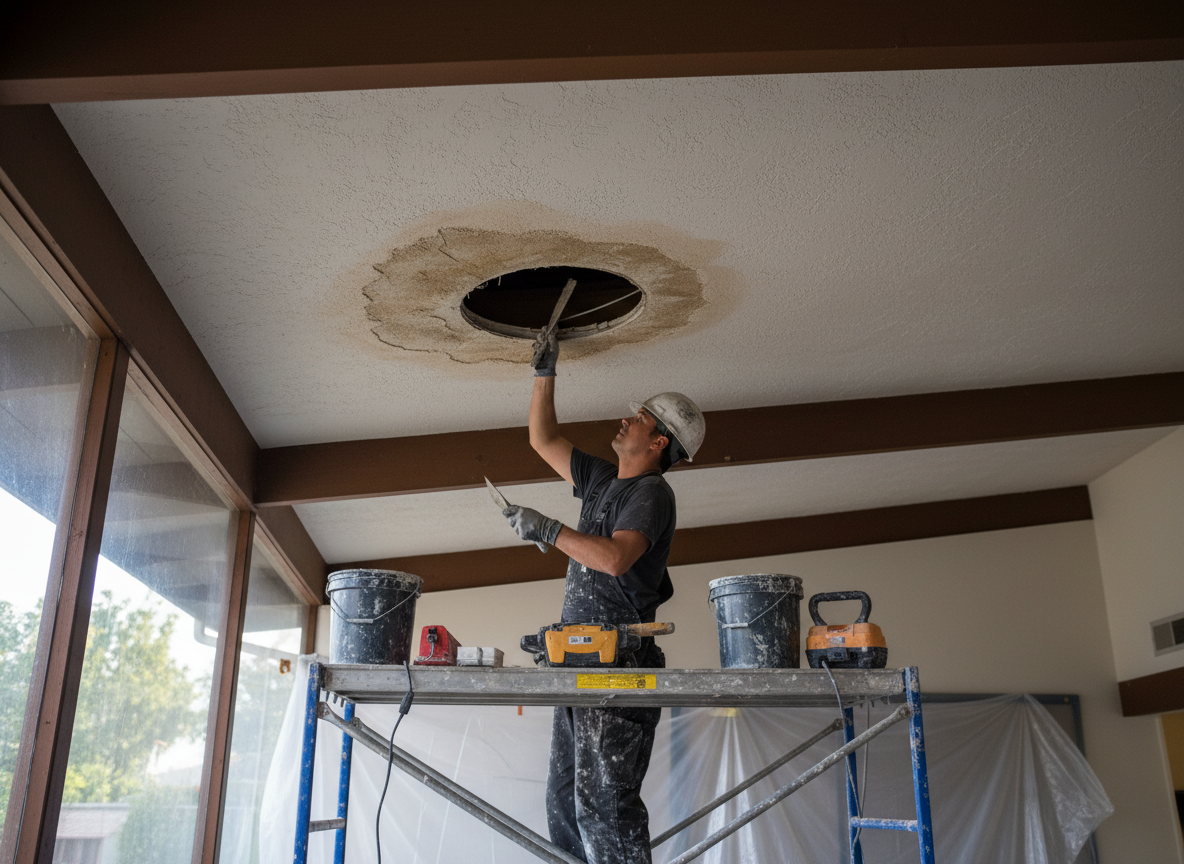
In Canoga Park homes built from the 1950s through the 1970s, ceiling water damage often starts with roof penetrations around HVAC lines or second-story bathrooms. Hot dry summers followed by sudden winter rains can push water through aging asphalt shingles and into the plaster or drywall layers above living spaces near Warner Center. Technicians must trace the path through multiple ceiling layers without disturbing the textured finishes that are standard in these neighborhoods.
Pierce College area properties frequently see ceiling saturation from condensate line failures during the warm months when AC units run nonstop. Once moisture reaches the joists, mold can form within 48 hours in the enclosed cavities typical of single-story ranch houses common between Canoga Park and Winnetka. Proper drying requires negative air machines placed to pull air through small access cuts rather than removing entire ceiling sections.
Los Angeles County code requires that any ceiling repair involving more than 10 percent of a room surface must meet current fire-rated assembly standards when the home sits in a high-density zone. Crews working from the 23217 Saticoy St base carry moisture meters calibrated for both drywall and lath-and-plaster systems found in Chatsworth border homes to avoid missing hidden pockets behind crown molding.
Water migrating from Woodland Hills ridgelines can travel along ceiling joists for 20 feet before showing as a stain, especially in homes with flat or low-slope additions added in the 1980s. Opening the ceiling from above when possible prevents unnecessary drywall waste and allows direct inspection of insulation that often holds moisture for weeks in the local climate.
Technician insight
In Canoga Park the thing that catches most people out with ceiling water damage repair is how far water travels along joists in the flat-roof additions common near Pierce College before any stain appears on the living-room side.
Hidden Leak Behind Textured Ceiling
A Canoga Park homeowner near Warner Center noticed a faint ring after heavy rain. Inspection found a roof vent boot failure allowing water to run 12 feet along ceiling joists. Crews opened two small access points from the attic, dried the cavity, treated for mold, and replaced the affected drywall while preserving the original texture.
How it works
- 1
Inspection and Moisture Mapping
Technicians arrive 24/7 and use meters to trace the full extent of saturation through ceilings in Canoga Park homes.
- 2
Source Containment
Plumbing or roof leaks are isolated so additional water does not reach joists near Westfield Topanga properties.
- 3
Drying and Antimicrobial Application
Equipment is staged to dry cavities while treating surfaces to limit mold growth common after summer rains.
- 4
Repair and Finish Matching
Damaged sections are replaced and textures matched to blend with original ceilings found in local housing stock.
Pricing
Cost depends on square footage affected, number of ceiling layers, and whether access must be created from above or below.