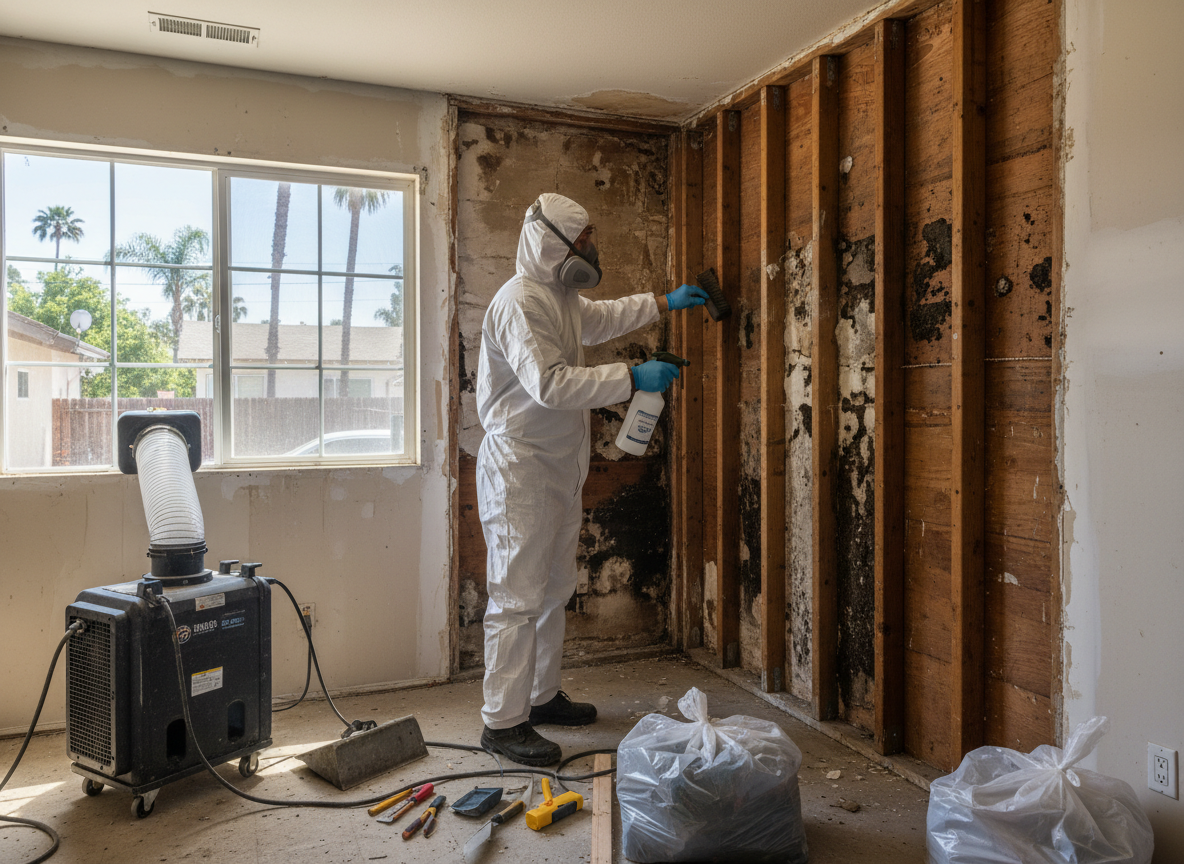
Water damage in Canoga Park often stems from plumbing leaks or roof issues in the area's post-war housing stock, where stucco exteriors and slab foundations trap moisture against wood framing. Hot, dry summers accelerate surface drying while leaving hidden pockets behind drywall and under cabinets, allowing mold to establish within 48 hours. Remediation requires removing affected porous materials, HEPA vacuuming, and negative air containment to prevent spores from migrating into adjacent rooms near Warner Center offices or Pierce College dorms.
Los Angeles County building practices from the 1960s mean many Canoga Park properties still contain original plaster and lath that absorb water differently than modern drywall. Technicians must cut back walls at least 18 inches beyond visible mold and use moisture meters on concrete slabs common in Winnetka and Chatsworth border homes. Failure to address subfloor moisture from seasonal rain runoff along the valley terrain leads to recurring growth even after hot summer weather returns.
Air scrubbing and antimicrobial application follow removal, but only after source correction like fixing the original leak. In neighborhoods around Westfield Topanga, HVAC systems can spread spores across multiple units if not isolated early. Documentation of moisture readings and material disposal protects homeowners when dealing with insurance adjusters who visit properties in Woodland Hills and Chatsworth.
Post-remediation verification includes third-party air sampling to confirm spore counts match outdoor baselines before reconstruction begins. This step is critical in Canoga Park's warm Mediterranean climate where rapid re-wetting from unexpected leaks can undo weeks of drying.
Technician insight
In Canoga Park the thing that catches most people out with mold remediation after water damage is how the 1950s slab-on-grade homes trap water under the concrete edge near the foundation, especially after runoff from the hills behind Warner Center. Homeowners think once the carpet is pulled the problem is gone, but the moisture keeps feeding growth behind the toe-kick for months.
Hidden Mold Behind Kitchen Cabinets
A slow dishwasher leak in a Canoga Park home near Pierce College went unnoticed until musty odors appeared. Inspection revealed mold extending into the subfloor and wall cavities behind cabinets. Crews removed the affected base cabinets and drywall, dried the slab edge, and applied antimicrobial treatment. Air clearance passed and the homeowner rebuilt without recurrence during the following dry summer.
How it works
- 1
Inspection and Moisture Mapping
Technicians arrive within hours, use meters and infrared cameras to locate all affected areas in walls, floors, and ceilings.
- 2
Containment Setup
Plastic barriers and negative air machines isolate the work zone to stop spore spread into living spaces.
- 3
Removal of Affected Materials
Cut out and bag moldy drywall, insulation, and baseboards for proper disposal outside Canoga Park.
- 4
Drying and Antimicrobial Treatment
Industrial dehumidifiers and air movers dry remaining structure while surfaces receive EPA-registered treatments.
- 5
Clearance Testing
Independent sampling confirms the space meets post-remediation standards before any rebuild work.
Pricing
Pricing varies by extent of hidden mold and square footage affected; on-site assessment provides accurate scope.