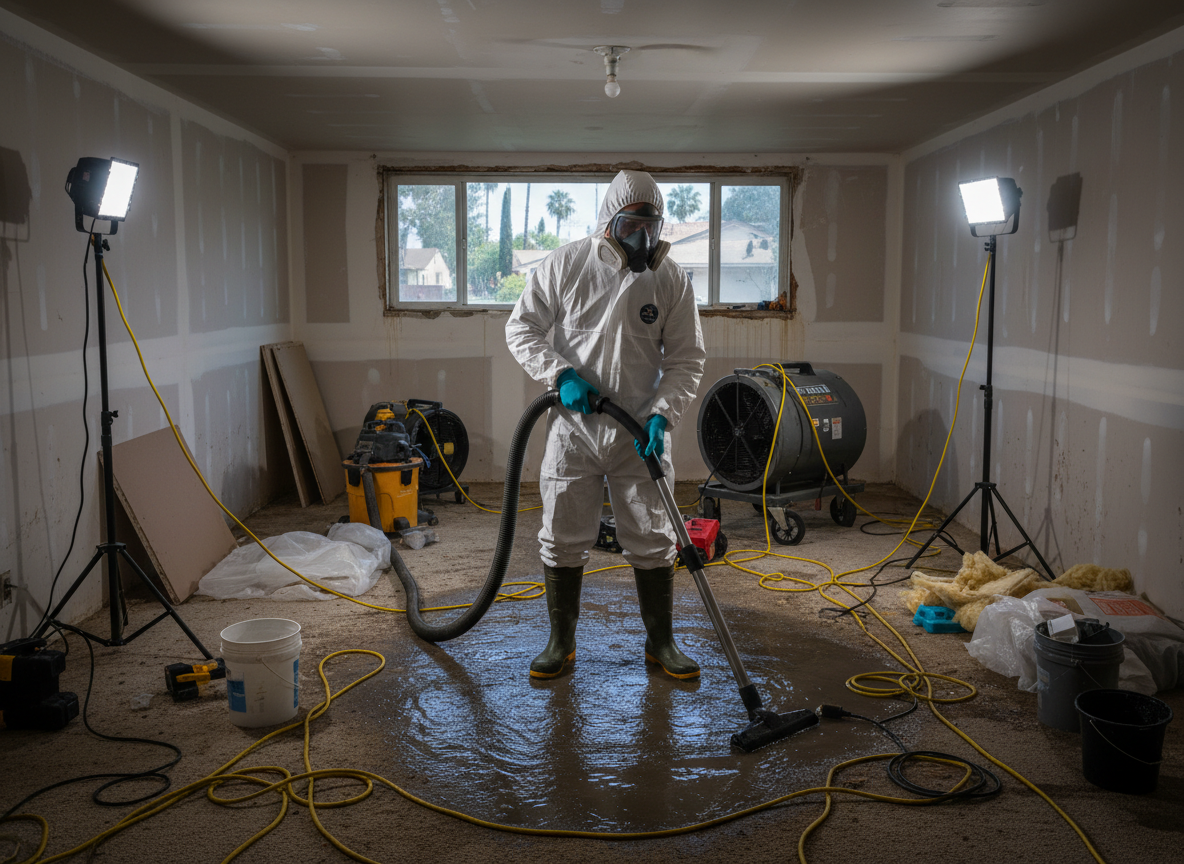
Canoga Park homes built in the 1950s and 1960s often feature plaster walls over wood lath and slab-on-grade foundations that trap moisture after leaks from older galvanized pipes. When water enters from a roof or appliance failure, it travels under vinyl tile or hardwood and into wall cavities, creating hidden pockets that must be opened and dried with directed airflow equipment. Hot, dry summers accelerate surface evaporation while leaving deeper saturation in place, so extraction within the first hours prevents mold on the porous materials common here.
Jobs near Westfield Topanga or along Topanga Canyon Boulevard frequently involve commercial spaces with suspended ceilings and carpet over concrete that hold water differently than residential settings. We map moisture with meters before removal, then use air movers and dehumidifiers sized for the square footage and local humidity swings. Properties close to Pierce College or in Warner Center also see runoff from parking lots during rare heavy rains that pools against foundations, requiring perimeter drainage checks before drying begins.
Cleanup in neighborhoods bordering Chatsworth and Winnetka means coordinating with Los Angeles County permitting when structural cuts are needed. We remove saturated baseboards and drill weep holes in drywall to promote airflow without unnecessary demolition. Once readings reach acceptable levels, we document conditions for insurance and leave the space ready for any follow-up repairs by the homeowner's contractor.
Technician insight
In Canoga Park the thing that catches most people out with water cleanup services is how quickly moisture moves under the slab or behind the stucco in homes from the 1960s. A small kitchen leak can reach the living room subfloor before anyone notices because the hot dry summers mask the smell until the damage spreads.
Kitchen Leak Into Adjacent Hallway
A supply line under the sink in a Canoga Park ranch home failed overnight. Water traveled under the vinyl and into the hallway drywall. We extracted the water, opened baseboards for airflow, and ran equipment for three days until readings were clear.
How it works
- 1
Arrival and Assessment
Technician arrives within hours, locates the water source, and uses moisture meters to map affected areas in Canoga Park homes.
- 2
Water Extraction
Remove standing water with portable pumps and wands suited to slab floors and carpet common in the area.
- 3
Drying Setup
Place air movers and dehumidifiers, then monitor daily until drywall and subfloors reach dry standards.
- 4
Final Documentation
Record moisture readings and provide a report for insurance or property records.
Pricing
Cost depends on the volume of water, number of affected rooms, and whether hidden cavities in older Canoga Park construction require additional drying time.